• Search

  • Post Date

  • Categories

  • Contributors

Long-Term Progressors and Elite Controllers: From Mississippi to Berlin

By Jane Mai, MD

June 15th, 2014

Dr. Jane Mai speaks about patients who have been “cured” of HIV infections – those patients who have no symptoms of HIV for greater than 10 years, and may have normal CD4 counts without significant decline. She reviews cell-mediated and humoral immunity and their involvement in a patient’s response to HIV infection and treatment. She also provides an overview of HIV pathogenesis, patient and viral factors that influence disease course, and possible targets for vaccines and new therapies. She also discusses patients who had seemingly achieved a clinical cure, including the Mississippi Baby, and Berlin Patients (Timothy Ray Brown).


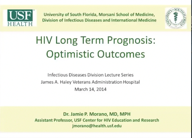
HIV Long Term Prognosis: Optimistic Outcomes

By Jamie Morano, MD

June 6th, 2014

Dr. Jamie Morano speaks about the long term outcomes in HIV-infected patients. She reviews immune reconstitution, the factors that lead to ART success, management of aging patients with longer lifespans, and implications for the future. Immune Reconstitution involves the expected recovery of the immune system when ART is initiated, while an unmodulated immune response characterized by worsening opportunistic infections is called IRIS. She also addresses HIV latency in other organ systems, HIV non-progressors, IRIS morbidity and mortality, and generational differences in HIV treatment outcomes. She touches on pre-exposure prophylaxis for high-risk individuals – men who have sex with men and intravenous drug users. Finally, she covers future infectious disease concerns for HIV patients, including MERS-CoV and reemerging vaccine preventable infections.

Antifungal Prophylaxis in Cancer Patients

By Rod Quilitz, Pharm.D., BCOP

June 6th, 2014

Rod Quilitz, PharmD, speaks about antifungal prophylaxis in cancer patients. Since these patients are largely immunocompromised, they are more susceptible to fungal infections, both by irritating manifestations like mucocutaneous candidiasis and potentially life-threatening invasive systemic fungal infections. However, antifungal medications can cause toxicity and drug interactions that must be balanced with the risk of infection in these patients. He covers candidiasis and aspergillosis, and the agents used to treat and prevent them. He also covers contraindications to antifungal prophylaxis.

Vaccine Health Disparities in the United States

By Jamie Morano, MD

June 6th, 2014

Dr. Jamie Morano speaks about health disparities regarding vaccination in the US and public health strategies to improve vaccination rates in the US population. She discusses the re-emergence of vaccine preventable diseases in the US, including measles and pertussis. She also speaks about the misconceptions about severity of these diseases and the risks/benefits of vaccines. She reviews the adult immunization schedule and common illnesses like pneumonia and influenza.

Review of Dermatology in HIV Infection

By Nancy Rihana, MD, FACP

June 6th, 2014

Dr. Nancy Rihana presents a review of dermatological manifestations and conditions associated with HIV infection. While opportunistic infections and Kaposi’s sarcoma have decreased in incidence with the advent of HAART, inflammatory skin conditions remain at constant levels of incidence. Reviewing the various cutaneous pathologies that occur in HIV-infected patients may prevent the clinician from stopping successful HAART due to suspicion for drug allergy. Dr. Rihana reviews exanthems expected at different CD4 counts, including syphilis, staphylococcus infections, scabies, lymphoma, fungal infections, shingles, psoriasis, and skin cancers among other conditions.

Beta-Lactam Allergy: The True Clinical Implication

By Guest Contributor

April 11th, 2014

Queenet Ibekweh, PharmD, speaks about the clinical implications of beta-lactam antibiotic (penicillin, carbapenem and cephalosporin) allergies. She discusses the different pathways of hypersensitivity reactions, cross-reactivity, epidemiology, pathophysiology, diagnosis, and management of penicillin induced adverse drug reactions. She also discusses the use of beta-lactam antibiotics in patients with documented penicillin allergies.

Screening and Prophylaxis Strategies for Recipients of Solid Organ Transplants

By Sally Alrabaa, MBBS

April 11th, 2014

Dr. Sally Alrabaa speaks about evaluation and management of infectious diseases in recipients of solid organ transplants. Multiple studies show improved outcomes with screening and prophylaxis for infectious disease in this population, especially for opportunistic pathogens. Important screening items include history of exposures, laboratory screening for viruses, colonization with multidrug resistant bacteria and TB, and fungal and parasite screening based on geography and exposure history. She covers infectious disease contraindications to solid organ transplantation, including active TB and HIV infections. Finally, she covers prophylaxis strategies like vaccinations, peri-operative antimicrobials, and lifestyle modifications to prevent infection.

Cryptococcus Gattii

By Joseph Halliday, DO

April 11th, 2014

Dr. Joseph Halliday discusses an emerging fungal pathogen, C. gattii and outbreaks in the Northwest US and British Columbia. C. gattii is an encapsulated yeast most often seen in immunocompromised patients, but epidemic varieties infect immunocompetent patients as well. He also discusses the presence of endemic C. gattii, clinical manifestations of this fungal infection, diagnosis, management, and complications.

Dates in ID: 20th Century Edition

By Richard L. Oehler, MD

April 11th, 2014

What disease caused a pandemic in 1968? When was the MMR vaccine first introduced for pediatric use? What was the Ebola virus named after? Keep watching and find out! Dr. Richard Oehler hosts an entertaining review of the history of infectious diseases in a game show format. Each question is followed by a short historical snippet to improve your knowledge of Infectious Disease trivia!

Zoonoses of Exotic Pets

By Lily Jones

February 26th, 2014

Dr. Lily Jones speaks about zoonoses from exotic pets – specifically select bacterial infections and their routes of transmission. She also discusses patients who are at high risk for zoonotic infections and their prevention. She speaks about infections associated with horses, deer, sheep, cattle, goats, birds, fish, reptiles, and exotic mammalian pets. She presents specific cases studies on Q fever, Brucellosis, Leptospirosis, Typhus, and Mycobacterium marinum infections.