Dr. Olga Klinkova, Infectious Diseases Clinician at the Moffitt Cancer Center and Research Institute, presents a talk on Candida Infections. Dr. Klinkova begins by discussing the epidemiology of Candida. She then touches upon the importance of biofilms on the pathogenicity of Candida strains. Next, she breaks down the individual Candida species and highlights unique characteristics of each one. Following this, she presents several unique cases of human Candida infections and through the cases, highlights Candida auris, oropharyngeal candidiasis, esophageal disease, and candidemia. Lastly, she closes with information on hepatosplenic candidiasis.
Archives
Research Methodology: Beyond the Jargon
Dr. Ambuj Kumar, Professor of Medicine with the USF Morsani College of Medicine, shares his perspectives on how to create and conduct a clinical research study. Among the topics discussed includes study design, the distinctions between randomized controlled trials, case-control studies, and retrospective cohort trials, and how to frame the proper clinical question for study development. The importance of having timely and specific communication, teamwork, and respecting deadlines is also emphasized.
HIV Dermatology 2025
Dr. Patrick Danaher, Infectious Diseases Clinician at the USF Morsani College of Medicine, discusses the various dermatologic manifestations of HIV in this recorded session. Among the topics discussed includes genital herpes disease, Zoster, Mpox infections, MRSA skin lesions, and Kaposi sarcoma. The lecture is presented in a case-based interactive format and is updated for 2025
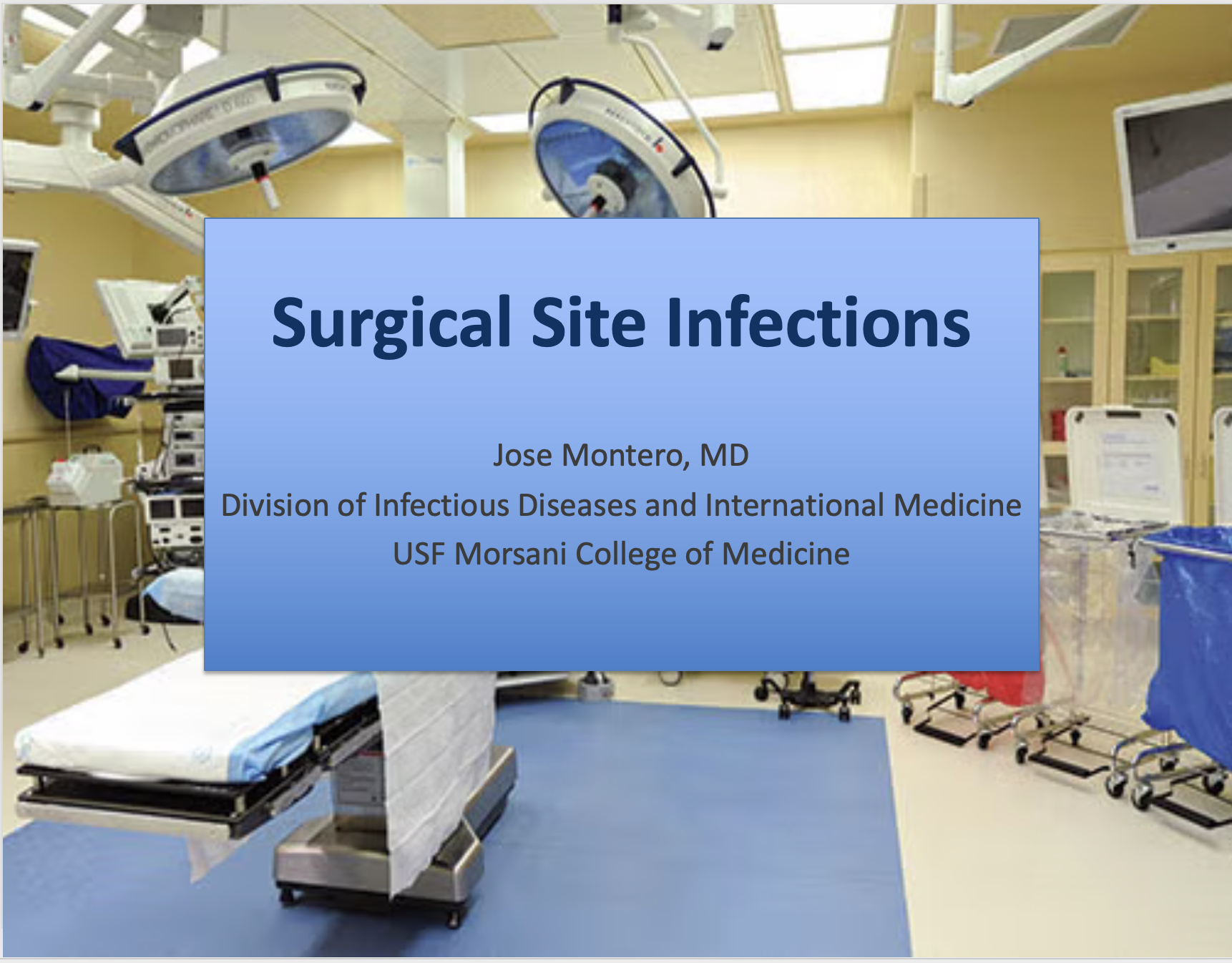
Surgical Site Infections
Dr. Jose Montero, Professor of Medicine at the University of South Florida Morsani College of Medicine, presents an overview of the management of Surgical Site Infections (SSIs) for an Infectious Diseases specialist. The lecture opens with a discussion of the history of SSI management, reviewing milestones in the prevention of these infections and their discoverers, from Semmelweis, to Lister, to Koch. Next, the sources of SSIs are differentiated. Dr. Montero then reviews risk factors for SSIs, and then covers prevention strategies. A major strategy for infection prevention during surgery is antimicrobial prophylaxis, and Dr. Montero highlights systemic and topical antimicrobials useful for this purpose, including timing of administration and duration. Lastly, the speaker focuses on MRSA as an SSI pathogen and offers special considerations for this organism.
ID Emergency: Malaria
Dr. Kami Kim, Chief of Infectious Diseases at the Division of Infectious Diseases, USF Morsani College of Medicine, reviews one of the few truly emergent infectious diseases, Malaria. Dr. Kim begins by discussing the differential of fever in the returning traveller. Next focusing on Plasmodium, she discusses diagnostic techniques, including thick and thin smears and Malaria rapid diagnostic tests. Similarities and differences of the individual species of Plasmodium are next discussed, including Falciparum, Vivax, Ovale, and Malariae. Lastly, the complications of Malaria infection are covered, followed by a brief discussion regarding Dengue virus disease.
Skin and Soft Tissue Infections
Dr. Jackie Sherbuk, Assistant Professor of Medicine with the USF Morsani College of Medicine, presents an interactive session regarding infections of the skin and soft tissues. Topics discussed include impetigo, folliculitis, furunculosis, cellulitis, necrotizing skin and soft tissue infections, aquatic cellulitis, animal bite infections, cutaneous anthrax, sporotrichosis, and staphylococcal scalded skin syndrome. A question and answer format is used, and the format is suitable for board preparation.
CNS Infections
Dr. Vivian Vega, Assistant Professor at the USF Morsani College of Medicine, presents a discussion about infections of the central nervous system. Dr. Vega begins by discussing encephalitis. Pathogens discussed include Herpes Simplex virus, West Nile virus, Enterovirus, Varicella Zoster, Arboviruses and Rabies. Next, bacterial meningitis is addressed. Lastly, causes of chronic meningitis are elucidated, and Eosiniphilic and health-care associated meningitis are briefly discussed.
Review of Tick-borne Infections
Dr. Ambika Eranki, Assistant Professor of Medicine at the USF Morsani College of Medicine, presents a review session on infections spread by Ticks. Dr. Eranki addresses specific tick-borne syndromes and arthropod vectors. The speaker also explains how climate change is affecting the distribution of arthropods critical to the spread of these diseases. Syndromes further discussed include Lyme disease, post-Lyme disease syndrome, Anaplasmosis, and Babesiosis.
Fungal Infections Review
Dr. John Greene, Professor of Medicine and Chief of Infectious Diseases at Moffitt Cancer and Research Institute, conducts this photo review of various human endemic fungal infections. Covered topics include mycetoma, chromoblastomycosis, phaeohyphomycosis, Sporotrichosis, cryptococcosis, histoplasmosis, blastomycosis, coccidioidomycosis, and paracoccidioidomycosis. The presentation is suitable for infectious diseases board examination testing.
Bone and joint Infections
Dr. Ambika Eranki, Assistant Professor at the Division of Infectious Diseases and International Medicine, presents this review of infections associated with native and prosthetic joints, in addition to infectious of the spine and vertebrae. Dr. Eranki begins by presenting some case based examples of bone and joint infections. She then discusses the definitions and workup of infectious arthritis, septic arthritis, vertebral osteomyelitis, and prosthetic joint infections. A brief review of infections of the diabetic foot is also presented. Dr. Eranki closes by sharing recent important medical publications for bone and joint infections and the diabetic foot.